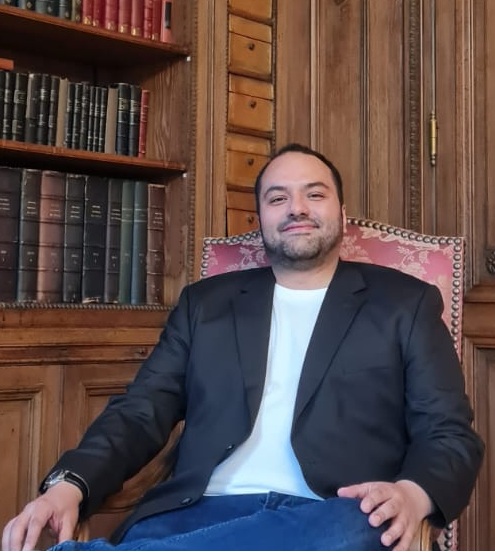
Alejandro Plaza Reveco
Doctoral Researcher
Humboldt-Universität zu Berlin
RTG Dynamics
Berlin, Germany

I am a Doctoral Researcher at the RTG Dynamics graduate program at Humboldt-Universität zu Berlin, jointly coordinated with the Hertie School of Governance. My research investigates how social networks mediate the relationship between institutions, civil society, life events, and political attitudes. Using comparative and longitudinal data, I explore how inequality and welfare regimes shape the structure and composition of individuals' personal networks—and, in turn, how these networks influence interpersonal trust and broader political orientations.

Between March and May 2025, I was a visiting researcher at the Swedish Institute for Social Research (SOFI) at Stockholm University, within the Social Policy Unit.

I hold a Master's in Sociology from the Pontifical Catholic University of Chile and a Bachelor's from the University of Chile. Prior to my doctoral studies, I was Technical Coordinator of ELSOC — COES, specialising in survey design, panel data, and network analysis.

02 ——

Research

I
Networks, Inequality & Social Stratification
+
2026
PublishedPlaza, Beck, Iturra-Sanhueza & Otero — Journal of Social Networks, 84, 27–45
2026
From Cohesion to Division: Macrostructural Factors Driving Class Homogeneity
Working paperPlaza — Draft version
2026
Social Mobility and Class Segregation in Personal Networks: Longitudinal Evidence from Chile
Under reviewOtero, Zavala & Plaza — Frontiers in Sociology
2026
Examining the Relevance of Social Capital and Class-Based Network Segregation in the Status Attainment Process
Working paperOtero & Plaza
2025
Stability and Evolution of the Size of Acquaintance Networks: A Longitudinal Analysis of the Chilean Context
Under reviewMuñoz, Plaza & Espinoza — Journal of Social Networks
2024
Book chapterPlaza, Cantillan & Muñoz — Social Networks: Theory, Methods and Applications in Latin America
2022
PublishedPlaza, Cantillan, Beck & Espinoza — Revista de Sociología, 37(1)
2020
PublishedBargsted, Espinoza & Plaza — Papers. Revista de Sociologia, 105(4), 583–612
II
Welfare States, Policy & Redistribution
+
2026
Timing and Conditions of Sexual Initiation in Chile: A Life-Course Analysis
Working paperPlaza — National Sexuality and Affectivity Survey
III
Social Cohesion & Collective Action
+
2025
PublishedFriehs, Plaza et al. — Journal of Community and Applied Social Psychology, 35:e70105
2025
Book chapterGonzález, Chayinska, Plaza & Carozzi — Social Unrest in Latin America (Ed. Çakal et al.)
2022
PublishedGonzález, Chayinska, Plaza et al. — European Journal of Social Psychology, 52, 1031–1046
2022
PublishedRozas-Bugueño, Plaza et al. — Revista Chilena de Derecho y Ciencia Política, 13(2)
03 ——

Teaching

Instructor of record
Sociology of Public Opinion and Social Media
Sociology undergraduate · School of Social Science, Andrés Bello University
Winter 2022
Analysis of Networks and Social Media
Master in Information Processing and Management · School of Engineering, PUC Chile
Summer 2020
Multivariate Statistics
Sociology undergraduate · Faculty of Social Sciences, University of Chile
Winter 2019
Graduate Teaching Assistant
Statistics I
MPP and MIA · Hertie School of Governance — Prof. Maria Uttenthal
Winter 2024
Multilevel Data Analysis
Master in Sociology · PUC Chile — Prof. Juan Carlos Castillo
Summer 2017
Advanced Statistical Techniques (SEM)
Master in Social Research Methods · Diego Portales University — Prof. Mónica Gerber
2015–2016
Linear Regression Analysis
Diploma in Statistics for Social Research · Diego Portales University — Prof. Mauricio Morales
Winter 2015
Undergraduate Teaching Assistant
Multivariate Statistics
Faculty of Social Sciences, University of Chile — Prof. Giorgio Boccardo
Summer 2017
Introduction to Economic and Political Thought
Faculty of Economics and Business, University of Chile — Prof. Oscar Landerretche
2013–2014
Social Stratification in Latin America
Faculty of Social Sciences, University of Chile — Prof. Carlos Ruiz Encina & Giorgio Boccardo
Summer 2013
Social History of Latin America
Faculty of Social Sciences, University of Chile — Prof. Carlos Ruiz Encina
Winter 2013
04 ——

Consulting

Social Network Analysis
Ego-network modelling, position generators, homophily measures, and longitudinal network dynamics — from survey design through final reporting.
R / igraphStataMultilevel
Longitudinal Data Management
Design and coordination of panel studies, database assembly, inconsistency analysis, and technical documentation — modelled on 4 years coordinating ELSOC (n≈3,000, 5 waves).
RSQLStataSPSS
Quantitative Methods Advisory
Sampling design, questionnaire validation, SEM / CFA, multilevel modelling, and policy-ready reporting for NGOs, public agencies, and academic teams.
SEM / AMOSPythonLaTeX
Selected engagements
Longitudinal Dataset Scoping
British Council · 2023
ELRI Longitudinal Database Management
Centre for Intercultural & Indigenous Research · 2020
QoL & Caregiver Burden Analysis
Andrés Bello University · 2018
Citizen Education Policy
Diego Portales University · 2017
User Satisfaction Study
Ministry of Labour, Chile · 2016
Reading Motivation Research (Fondart)
Project 434996 · 2019–2020
05 ——

Writing

A 5 años del 18-O: ¿Quiénes son y dónde están los nuevos manifestantes del Estallido Social?
Co-authored with Joaquín Rozas
CIPER Chile
Pensar la política científica más allá de Becas Chile
Co-authored with Salvador Vargas
CIPER Chile
Rotonda Atenas y Cohesión Social
On urban space and social cohesion in Santiago
La Segunda
Governing in the name of reason: towards a theoretical delimitation of technocracy from Latin America
In Ipar & Tonkonoff (Eds.) — Theory, Politics and Society · 2018
Book chapter
Conceptual elements for the analysis of Technocracy: Towards a theoretical definition
Revista Némesis, 11 · 2015
Revista Némesis
Social stratification in Latin America and educational inequality — Interview with Florencia Torche
Revista Némesis, 13 · 2016
Interview

Stories forthcoming. This space is reserved for narrative work — fiction that orbits the same questions as the research: class, networks, and the texture of social life.